

Skip to content

Kinvent 3D Deltas

by Kinvent
Original price $28,000.00 - Original price $28,000.00
Original price
$28,000.00
$28,000.00 - $28,000.00
Current price $28,000.00

✓ Authorized Kinvent Dealer
✓ Lowest Price Guaranteed
✓ FREE & FAST Shipping: In Stock and Ready to Ship
✓ Questions? Call an RFA Team Member: 1-855-864-6442

Three-Axis Force Plates

Kinvent 3D Deltas

Kinvent call these the next-gen portable 3-axis force plates, and the headline is the third axis. The 3D Deltas record horizontal, lateral and vertical ground force at the same instant. A vertical-only plate tells you how hard an athlete pushed into the floor. These plates also tell you how much of that push went sideways and how much went forwards or backwards, which is what a cutting step, a skater jump or a braking stride is actually made of.

Kinvent position the system for elite performance, rehabilitation and biomechanical analysis, and they name the same tests a testing session already runs: CMJ, squat jump, drop jump, broad jump, lateral bound, skater jump, single-leg hop, change of direction. The difference is what comes back from each one. Entry speed, braking impulse, ground contact time, lateral RSI and load transfer only exist because the horizontal channels were recording.

Axes Measured
X / Y / Z
Horizontal, lateral, vertical
Dimensions
47.2" x 17.71" x 31.49"
On record with RFA
Weight
105 lbs
On record with RFA
Transport
Portable
Kinvent show a wheeled case
Change of direction Video and force synchronised Smart Mode auto-detection Kinvent app
Kinvent 3D Deltas three-axis force plates

How The Capture Works

Four Things Define This System

The axes it reads, the horizontal tests those axes make possible, the visual layer sitting on top of the force trace, and the way a session starts without setup.

🧭
3D force measurement
Kinvent describe the plates as tracking horizontal, lateral and vertical ground forces across X, Y and Z. They put that capture to work on deceleration, stability and re-acceleration, which is the sequence a change of direction is made of and the sequence a vertical trace cannot separate.
X / Y / Z
↗️
Directional strength testing
Skater jumps, lateral bounds, broad jumps, single-leg hops and drop or side jumps are the tests Kinvent name for assessing directional strength. Each one sends a large share of its force across the surface rather than straight down, and peak force, RFD, impulse and RSI come back for all of them.
Lateral and horizontal
🎥
Motion capture alongside force
Kinvent pair the force measurement with visual analysis: real-time feedback, video and force synchronisation, force vector visualisation, and joint angle observation. The value is being able to point at the frame where the force went wrong instead of describing it from a graph afterwards.
Force vectors on video
⚡
Smart Mode
Smart Mode detects jumps and movements automatically during a session. Kinvent list it as no setup required, instant data logging and a faster testing workflow, which is what matters when a squad walks through a testing bay and nobody has time to arm a trial per athlete.
No setup required

What Comes Back

The Indicators Kinvent Publish

Every value below is one Kinvent name for the 3D Deltas. The horizontal ones are the reason the third axis exists.

📈
RFD
Rate of force development
⏱️
Impulse
Force multiplied by time
🔁
RSI
Reactive strength index
👣
Ground Contact Time
Time spent on the plate
🛑
Braking Impulse
Deceleration side of the cut
⚖️
Symmetry
Left against right
🔀
Load Transfer
Where the load goes
🧮
Force Velocity Profile
Per athlete profiling
📊
DSI
Dynamic strength index

Tested Movements

What The Third Axis Buys You

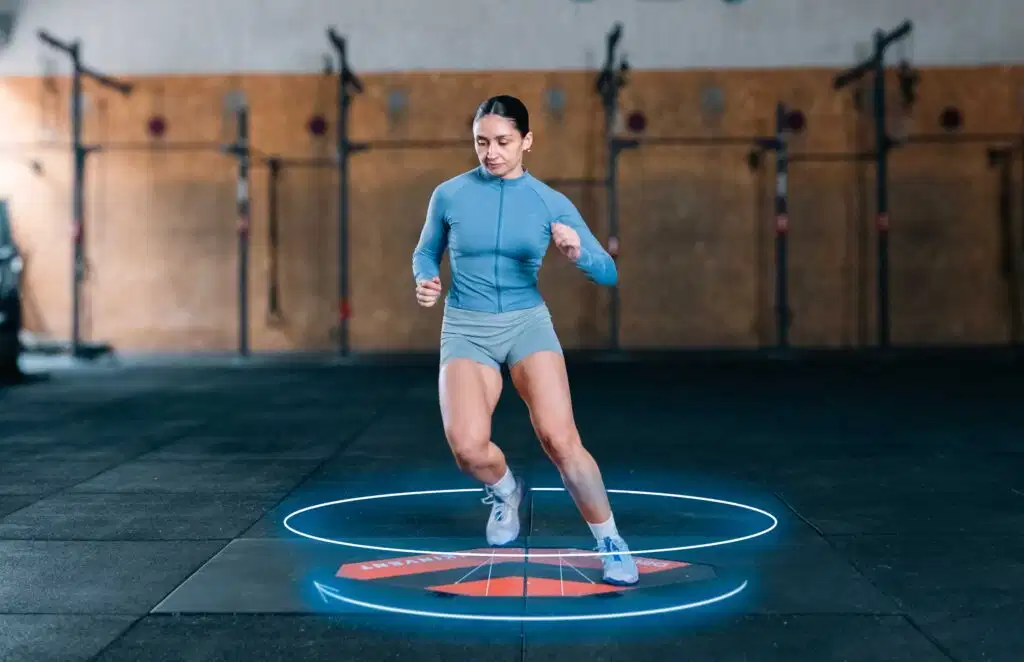
Athlete performing a change of direction test on Kinvent 3D Deltas force plates
Change of direction

Deceleration, stability, re-acceleration

A cut is three problems in sequence: stop the body, hold it, send it somewhere else. Kinvent split the 3D capture along exactly those lines, and the reason they can is that the braking and the redirection happen in the horizontal channels. They state the purpose plainly as improved performance and reduced injury.

  • Entry speed and braking impulse
  • Ground contact time and lateral RSI
  • Symmetry and load transfer
COD testing Horizontal force
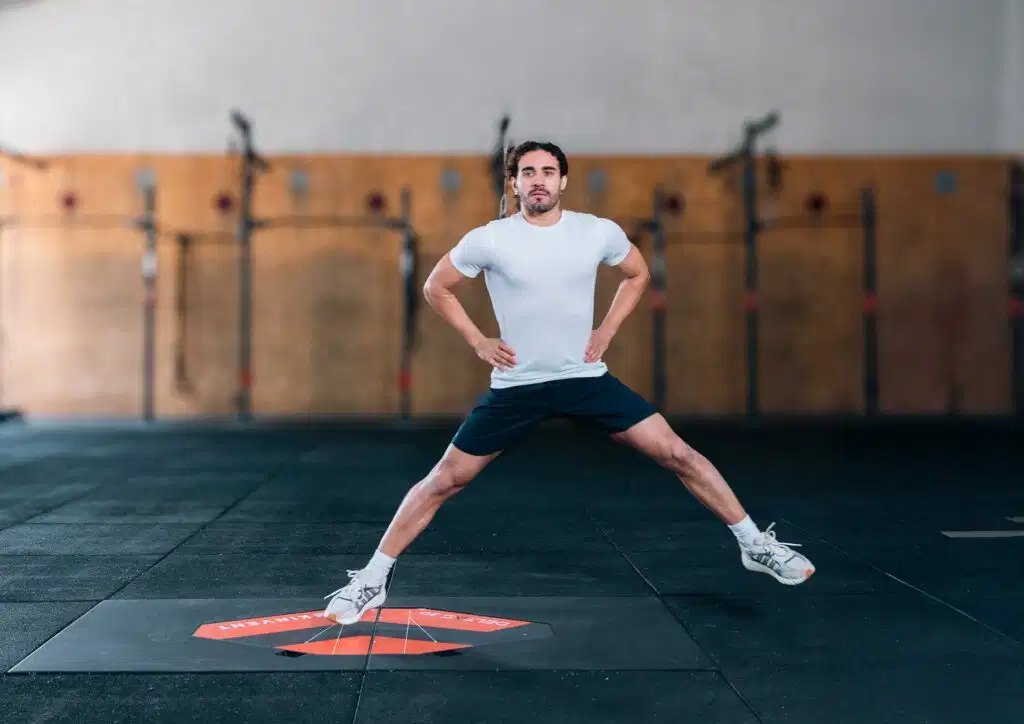
Lateral bound test recorded on Kinvent 3D Deltas force plates
Lateral and horizontal

Directional strength, measured directionally

Kinvent list skater jumps, lateral bounds, broad jumps, single-leg hops and drop or side jumps as the way to assess directional strength on this system. Run any of them on a vertical-only plate and the number you get describes the smaller half of the task. Here the output set is peak force, RFD, impulse and reactive strength index for each.

  • Skater jump and lateral bound
  • Broad jump and single-leg hop
  • Drop jump and side jump
Peak force and RFD Impulse RSI
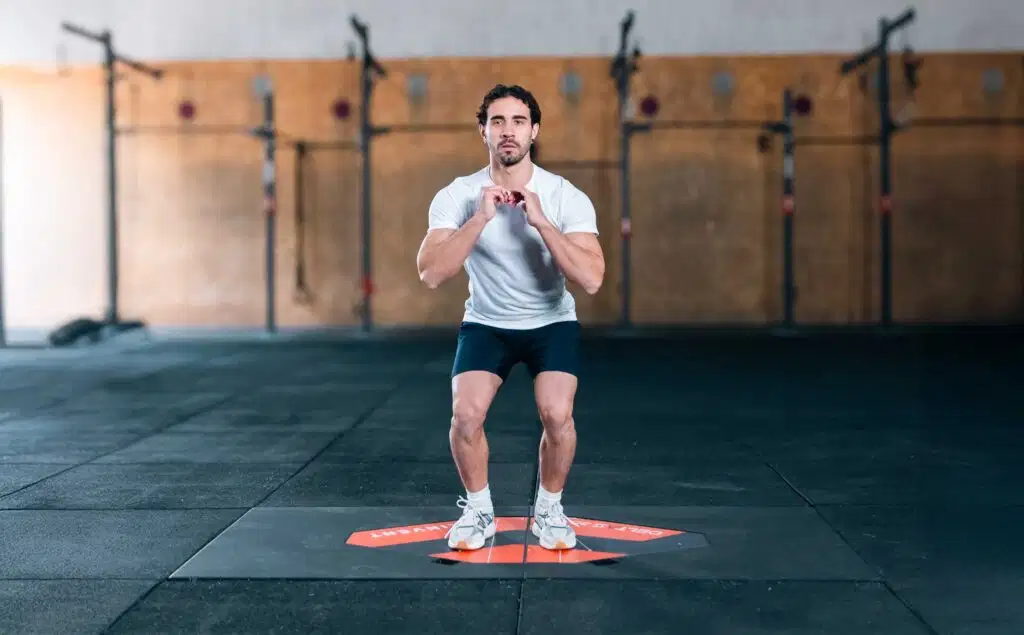
Squat jump test on Kinvent 3D Deltas force plates
Vertical and functional

The standard battery still runs here

Adding two axes does not cost you the tests you already run. Kinvent name jump height, peak power and reactive strength through CMJ, squat jump and drop jump, plus force velocity profiling and balance and landing control. Functional work sits in the same app: squats, bridges, push-ups, sit-to-stand and single-leg balance.

  • CMJ, squat jump, drop jump
  • Force velocity profiling
  • Balance and landing control
  • Squat, bridge, push-up, sit-to-stand
Jump height Peak power Single-leg balance
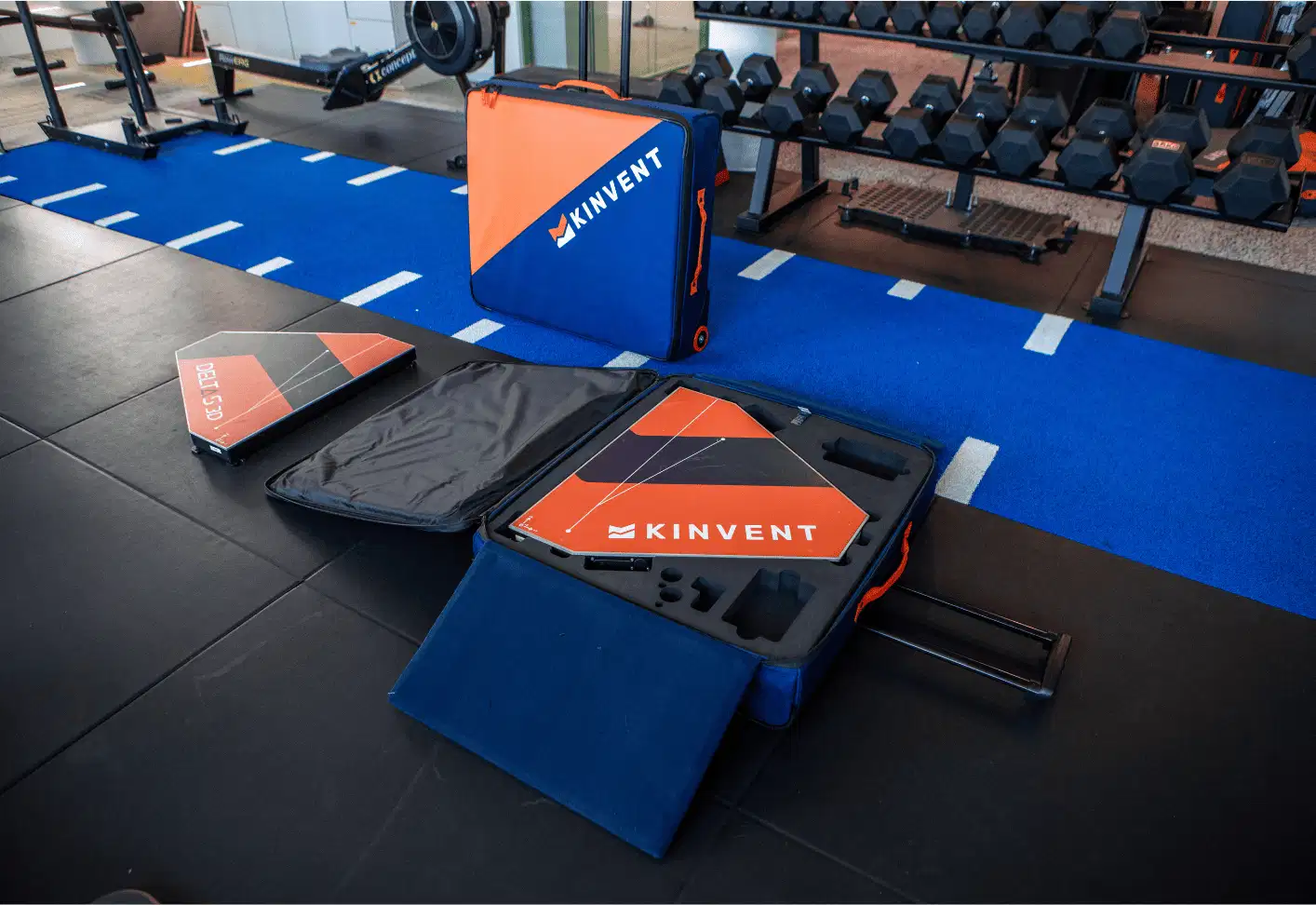
Kinvent 3D Deltas force plates with their transport case
Transport

A three-axis system that travels

Kinvent describe the 3D Deltas as portable 3-axis force plates and show them packed into a wheeled transport case. Three-axis capture has historically meant a plate set into a laboratory floor, so the case is the part of this product that changes where the testing can happen: a camp, an away facility, a clinic that does not own the room.

Wheeled case Portable

Where It Earns Its Place

Who Kinvent Built This For

Kinvent name physical therapists, sports performance professionals, physicians, researchers and elite athletes as the users of this system.

🦵
Return to sport after ACL
Kinvent list return-to-sport insights for ACL injury, with the aim of assessing recovery objectively rather than by eye.
🩹
Tendinopathy and sprain
Tendinopathy, sprain and muscle injury are the other three return-to-sport cases Kinvent name for this system.
🏉
Elite performance
Kinvent place the 3D Deltas in elite performance work, giving objective data on how an athlete produces and absorbs force.
🔬
Biomechanical analysis
Multidirectional force measurement for movement, balance and load distribution, which is the research case Kinvent state.
⚖️
Asymmetry detection
Asymmetry detection is a named output. With three axes, a side-to-side difference can show up horizontally as well as vertically.
🏃
Functional evaluation
Functional performance evaluation across squats, bridges, push-ups, sit-to-stand and single-leg balance tests.

The Kinvent Plate Range

Three Plate Systems, One App

The choice comes down to how many axes you need and what you intend to test.

Kinvent K-Force Plates
K-Force Plates
Portable plates for balance, posture and force distribution work.
Balance and posture Force distribution Portable
Shop the K-Force Plates Shop the K-Force Plates
Kinvent K-Deltas
K-Deltas
Large plates for dynamic vertical force, jump testing and bilateral symmetry.
Jump analysis Symmetry Large surface
Shop the K-Deltas Shop the K-Deltas
You're Here
Kinvent 3D Deltas
3D Deltas
Three-axis capture for change of direction, lateral and horizontal testing.
Horizontal, lateral, vertical Change of direction Video and force sync Smart Mode
Currently viewing

Full Spec Sheet

Specifications

Measurement

Axes 3 (X, Y, Z)
Force components Horizontal, lateral, vertical
Sampling frequency Not published by Kinvent
Capacity and accuracy Not published by Kinvent

Physical

Dimensions 47.2" x 17.71" x 31.49"
Weight 105 lbs
Transport Wheeled carry case

Software

Platform Kinvent app
Session mode Smart Mode auto-detection
Video Video and force synchronisation
Visualisation Force vectors and joint angles
Ecosystem Integrated with other Kinvent sensors

Ordering

SKU 15-4387

Trusted & Certified

Kinvent's published certifications

These are the certifications and registrations Kinvent publish for their platform and their quality and information security systems. They cover the company and its medical device and data handling, not a performance claim about this sensor.

CE
CE Mark
European Union conformity
FDA
FDA
US Food and Drug Administration
HC
Health Canada
Medical device registration
13485
ISO 13485
Medical device quality management
9001
ISO 9001:2015
Quality management
27001
ISO 27001:2022
Information security management
HDS
HDS
French health data hosting
🔒
HIPAA
Healthcare privacy compliance

Who Uses Kinvent

Over 10,000 professionals and organizations

Kinvent name the following among the organizations working with their sensors. The list is theirs, published on their own product pages.

HSS
Hospital for Special Surgery
Orthopedics and sports medicine
MLB
Major League Baseball
Professional baseball
NFL
National Football League
Professional football
NBA
National Basketball Association
Professional basketball
MLS
Major League Soccer
Professional soccer
🎓
Stanford University
Collegiate athletics and research

Questions

Frequently Asked Questions

The two horizontal components of the ground reaction force. Kinvent describe the 3D Deltas as tracking horizontal, lateral and vertical ground forces across X, Y and Z. A step that drives the body sideways is therefore measured as a sideways push rather than inferred from the vertical trace underneath it.
Six, in three pairs: entry speed and braking impulse, ground contact time and lateral RSI, and symmetry and load transfer. Kinvent frame the purpose as assessing deceleration, stability and re-acceleration to improve performance and reduce injury.
Kinvent name CMJ, squat jump and drop jump for vertical work, skater jumps, lateral bounds, broad jumps, single-leg hops and drop or side jumps for directional strength, change of direction, and functional movements including squats, bridges, push-ups, sit-to-stand and single-leg balance.
Automatic detection of jumps and movements during a session. Kinvent list three things it changes: no setup required, instant data logging and a faster testing workflow. You are not arming a trial before each athlete steps on.
Yes. Kinvent pair force measurement with visual analysis and name four things it gives you: real-time feedback, video and force synchronisation, force vector visualisation and joint angle observation. They publish no camera specification, resolution or frame rate, so ask us if your protocol depends on those.
Kinvent call them portable 3-axis force plates and show them packed in a wheeled transport case. The figures on record with us are 47.2" x 17.71" x 31.49" and 105 lbs, so plan for a two-person lift and a vehicle rather than a shoulder bag.
No. Kinvent publish no sampling frequency, load ceiling or accuracy figure for the 3D Deltas. What they do publish is the measurement itself, the tests it supports and the indicators it returns. The figures published for the K-Deltas belong to that product and we will not carry them across. Ask us and we will put the question to Kinvent directly.
Yes. Asymmetry detection is one of the reasons Kinvent give for choosing this system, and symmetry and load transfer are named among the change-of-direction metrics. Because the capture is three-dimensional, a difference between limbs can appear in the horizontal channels as well as the vertical one.
Kinvent name four cases: ACL injury, tendinopathy, sprain and muscle injury. Their stated aim is objective assessment of recovery. They publish no discharge threshold or pass mark, so the criteria stay yours and the plates supply the numbers you set them against.
Kinvent list RSI, RFD, distance, velocity, acceleration and force velocity profiling as sport-specific indicators, plus peak force, impulse, lateral RSI, ground contact time, DSI, jump height and peak power across the test set. They publish the indicators rather than the calculation methods behind them.
Axes. K-Deltas cover vertical force during dynamic movement, with published figures for capacity, sampling rate and accuracy, and they handle jump testing and bilateral symmetry thoroughly. The 3D Deltas add the horizontal and lateral force components, which is what change of direction, lateral bounds and broad jumps draw on.
Yes. Kinvent list integration into their ecosystem as one of the reasons to choose the system, so it runs alongside the other K sensors under one athlete profile in the Kinvent app.
Kinvent name physical therapists, sports performance professionals, physicians, researchers and elite athletes. The buyer here wants three-dimensional force data and has a use for the horizontal channels, otherwise the K-Deltas cover vertical testing at lower cost.
Kinvent publish no package contents list and no warranty term for the 3D Deltas, so this page states neither. Their imagery shows the plates in a wheeled transport case. Contact us before ordering and we will confirm the current shipped configuration and warranty in writing.


  • Measures: three-axis force, vertical, lateral and anterior-posterior, captured simultaneously
  • Measurement range: Kinvent publish no load ceiling for this system
  • Accuracy: no accuracy figure appears in Kinvent's material for the 3D Deltas
  • Sampling rate: none published; the rate given for the K-Deltas platforms belongs to that product alone
  • Dimensions: 47.2 x 17.71 x 31.49 in
  • Weight: 105 lbs
  • App: K-Force app
  • What it records: RSI, RFD, distance, velocity, acceleration, force-velocity profiling and asymmetry detection
  • Measures: vertical, lateral and anterior-posterior force simultaneously, across the X, Y and Z axes
  • Full vector: one trial carries the complete ground reaction vector, so horizontal force is measured rather than inferred
  • Kinvent's category: multi-axis force, postural analysis and gait analysis
  • Movements listed: broad jump and change of direction, alongside jumps and landings
  • Indicators: RSI, RFD, distance, velocity, acceleration and force-velocity profiling
  • Asymmetry: imbalances and compensations between sides reported per trial, in horizontal channels as well as vertical
  • Footprint: 47.2 x 17.71 x 31.49 in and 105 lbs, specified as a fixed installation with a clear approach
  • Ecosystem: reports into the K-Force app alongside every other Kinvent sensor under one profile
  • Who specifies it: biomechanics laboratories, research groups, professional performance departments and sports medicine services
  • 3D Deltas three-axis force platforms
  • Accessories: Kinvent publish no itemised parts list for this system, so confirm the delivered configuration with us before ordering