

Skip to content

Kinvent K-Move

by Kinvent
Original price $690.00 - Original price $690.00
Original price
$690.00
$690.00 - $690.00
Current price $690.00

✓ Authorized Kinvent Dealer
✓ Lowest Price Guaranteed
FREE & FAST Shipping: In Stock and Ready to Ship
✓ Questions? Call an RFA Team Member: 1-855-864-6442

Angles On Record

Kinvent K-Move

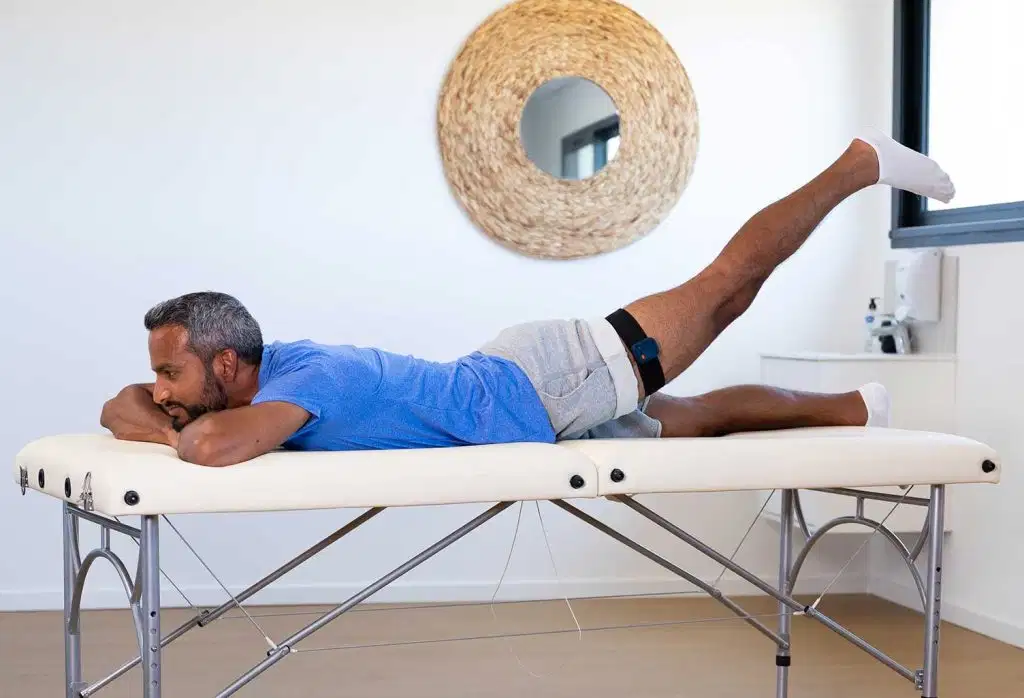
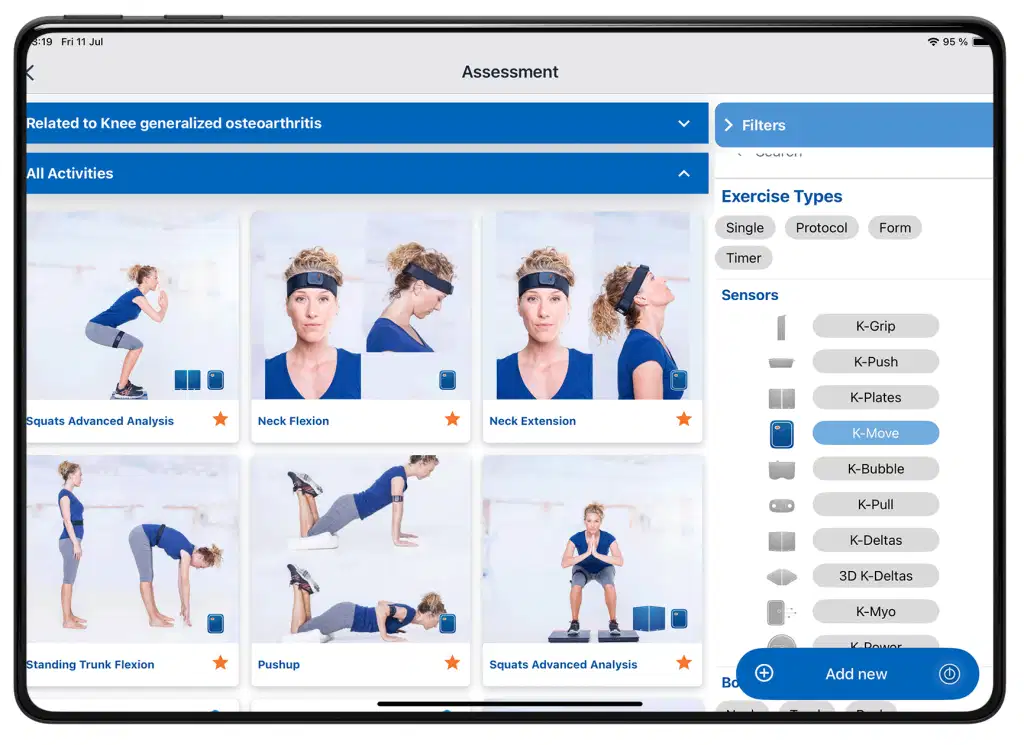
K-Move is a connected goniometer. It measures how far a joint travels in a chosen anatomic plane, covering flexion, extension, abduction, adduction and rotation, and it writes the reading straight into the K-Force app. Inside the housing is a nine-degree-of-freedom inertial unit combining an accelerometer, a gyroscope and a magnetometer.

Kinvent publish accuracy better than 0.5° for the angle measurement, and a seven-hour battery for the sensor. A maximum amplitude captured for a joint becomes the 100% reference the app works from afterwards, including the target games, whose difficulty can be set as a percentage of that maximum across ten levels. Physiotherapists, clinic teams and sports medicine staff are who Kinvent build it for. Accessories are included with the sensor.

Angle accuracy
Under 0.5°
Kinvent's published figure
Inertial unit
9 DOF
Accelerometer, gyroscope, magnetometer
Battery
7 hours
Per Kinvent's listing
Weight
2.2 lbs
As listed with accessories
Range of motion 9-DOF IMU Left and right comparison K-Force app
Kinvent K-Move

The Measurement

What a connected goniometer adds

A manual goniometer gives you a number that then has to be written down. K-Move takes the same angle and files it against a profile, with a published tolerance attached to it.

📐
Accuracy stated in degrees
Kinvent publish better than 0.5° for K-Move, which is a figure you can plan a repeat measurement around. It is the one number they attach to the angle reading, and it is the one to hold them to.
< 0.5°
🧭
Nine degrees of freedom
Three sensors work together in the unit: an accelerometer for linear motion, a gyroscope for rotation, and a magnetometer for heading. Nine axes of data produce one joint angle.
9 DOF
↔️
Side against side
The app holds readings for both limbs, so the angle reached on one side can be read against the other in the same view. Symmetry is a comparison the sensor supports directly.
Symmetry
🔋
Seven-hour battery
Kinvent list seven hours of use for the unit, which covers a full clinic day of short measurements without a charging break in the middle of it.
7 hours

In The Room

How K-Move gets used

One sensor, one number, and an app that keeps it. Everything listed here is drawn from what Kinvent state about the device.

📐
Joint angle in degrees
Range of motion
🔄
Flexion and extension
Anatomic plane
↗️
Abduction, adduction, rotation
Plane selected
🎯
Maximum stored as a reference
100% marker
🎮
Ten difficulty levels per game
Target work
📊
Readings kept under one profile
K-Force app
🧳
Small enough to travel
2.2 lbs
🔗
Runs beside the force plates
Same app

Closer Look

Taking the reading, then using it

Kinvent K-Move
Measuring

One joint, one plane, one figure

You choose the joint and the plane, then take the largest amplitude the movement reaches. Kinvent quote better than 0.5° on that reading. The nine-degree-of-freedom unit inside works out where the sensor is pointing from accelerometer, gyroscope and magnetometer data together.

  • Flexion, extension, abduction, adduction and rotation
  • Accuracy published as better than 0.5°
  • Nine axes of inertial data behind each angle
  • Reading lands in the K-Force app as it is taken
Goniometer 9 DOF
Kinvent K-Move
Targets

The maximum becomes the scale

Once a maximum amplitude is recorded, it stands as the 100% mark for everything that follows. Game targets are set as a percentage of it, and each game carries ten levels of difficulty. A session run at 60% of a stored maximum is a defined piece of work with a number attached to it.

  • Maximum amplitude held as the 100% reference
  • Targets set as a percentage of that maximum
  • Ten levels of difficulty in each game
  • Angle data sits alongside K-Force Plates or K-Deltas readings
Percentage targets Ten levels

Motion And EMG

K-Move next to its two neighbours

Kinvent group three sensors away from the force family. This one answers how far a joint moved. The other two answer how fast a body or bar travelled, and how hard a muscle fired.

Kinvent K-Power Velocity Training Sensor
K-Power
Motion sensor combining IMU and UWB.
IMU + UWB Motion K-Force app
Shop the K-Power
You're Here
Kinvent K-Move
K-Move
Connected goniometer for joint range of motion.
Range of motion Goniometer K-Force app
Currently viewing
Kinvent K-Myo
K-Myo Duo Pack
Surface EMG sensors for muscle activation.
Surface EMG Two sensors K-Force app
Shop the K-Myo Duo Pack

Questions

Frequently Asked Questions

Joint range of motion, in degrees. Kinvent categorise it as a connected goniometer, and it records the amplitude a joint reaches in a nominated anatomic plane.
Kinvent name flexion, extension, abduction, adduction and rotation. The measurement is taken for one joint in one plane at a time.
Kinvent publish better than 0.5°. That is the only accuracy figure they state for this sensor, and it belongs to K-Move alone.
Three sensing elements of three axes each: an accelerometer, a gyroscope and a magnetometer. Their combined output is what the unit resolves into a joint angle.
Seven hours, as Kinvent list it. They give no charge-time figure, so we do not print one.
It sets the scale. The largest amplitude recorded for that joint counts as 100%, and later target work is expressed as a percentage of it.
They are target exercises inside the app. Each carries ten levels of difficulty, and the target itself can be set as a percentage of a stored maximum evaluation.
Yes. Kinvent list symmetry analysis for K-Move, so an angle taken on the left can be read against the same measurement on the right.
It does. Kinvent name the K-Force Plates and the K-Deltas as sensors to run alongside it, and every unit in the range reports into the K-Force app.
The listing states that accessories are included without itemising them. Kinvent publish no parts list for this sensor, so ask before you assume a particular strap or mount is in the box.
11.81 in × 3.74 in × 7.87 in and 2.2 lbs as listed. Those figures cover the sensor with its accessories.
No. Kinvent state the angle tolerance and the battery life for this unit and nothing about sampling frequency, so the two figures above are what we will put in writing.
  • Measures: joint angle and range of motion, in degrees
  • Accuracy: better than 0.5 degrees
  • Sampling rate: Kinvent publish no sampling frequency for this sensor
  • Inertial unit: 9 degrees of freedom, accelerometer, gyroscope and magnetometer
  • Dimensions: 11.81 x 3.74 x 7.87 in
  • Weight: 2.2 lbs, as listed with accessories
  • Battery life: 7 hours; no charge time is published
  • App: K-Force app
  • What it records: maximum amplitude per joint and plane, symmetry between limbs, and target sessions as a percentage of a stored maximum
  • Measures: joint range of motion, in degrees, for one joint in one anatomic plane at a time
  • Movements: flexion, extension, abduction, adduction and rotation
  • Accuracy: better than 0.5 degrees, as Kinvent publish it
  • Inertial unit: nine degrees of freedom, combining an accelerometer, a gyroscope and a magnetometer
  • Reference: the largest amplitude recorded for a joint is held as the 100% mark for later work
  • Targets: game targets set as a percentage of that stored maximum, with ten difficulty levels in each game
  • Symmetry: readings for both limbs held together so one side reads against the other
  • Battery: seven hours of use per Kinvent's listing
  • Recording: the angle lands in the K-Force app as it is taken, with no transcription step
  • Who uses it: physiotherapists, clinic teams and sports medicine staff
  • 1 K-Move connected goniometer
  • Accessories: the listing states that accessories are included without itemising them, so ask before you assume a particular strap or mount is in the box